I don’t remember the exact words, but I remember the feeling.
There was a moment when part of me insisted it had done enough. I said the tire was flat. That should have been sufficient. Another part of me—quieter, steadier—asked a different question. Did you ask them to help you fix it?
That’s usually how it goes.
My stubborn self states the truth and waits.
My better self asks the question that moves things forward.
My Stubborn Self:
“It was enough for me to tell them the tire was flat. They should’ve known what to do.”
My Better Self:
“They should’ve. No argument there. But did you ask them to help you fix it?”
My Stubborn Self:
“No. That shouldn’t be necessary.”
My Better Self:
“Necessary? Maybe not. Effective? Almost always.”
There’s a pause there—the kind where heels dig in.
My Stubborn Self:
“If people need to be told what to do, that’s on them.”
My Better Self:
“Maybe. But if the goal is movement, not moral victory, questions move things that statements don’t.”
That’s the lesson I keep relearning.
Statements describe reality.
Questions change it.
That’s why Navy commands get repeated back—not for ceremony, but for clarity and follow-through. That’s why a good mechanic doesn’t just say, “Your tires are wearing unevenly,” and walk away. He asks, “Do you want us to rotate them?”
Not because the truth was unclear.
Not because the listener was dull.
But because truth aims at fruit.
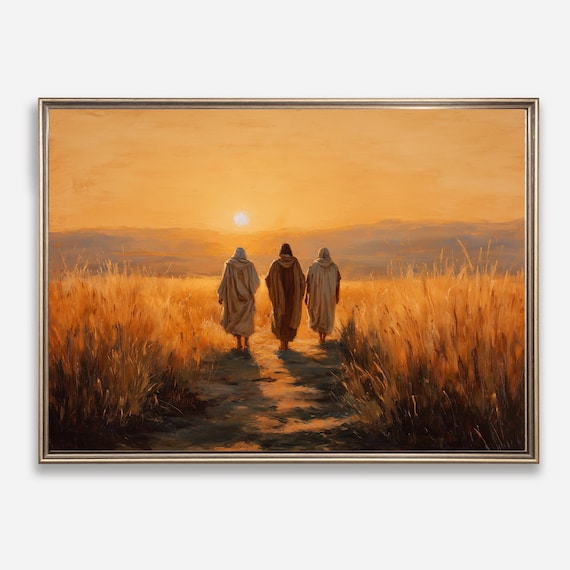
A More Powerful Image: The Road to Emmaus
If the flat tire feels too ordinary, Scripture gives us a deeper picture.
On the road to Emmaus (Luke 24), two disciples walk with heavy hearts. They are stuck. They are doing exactly what my stubborn self does—they are stating the truth of their disappointment and waiting for something to change.
“We had hoped that he was the one who was going to redeem Israel.”
That’s a true statement.
It’s also a stationary one.
Jesus joins them on the road. And what’s striking is not what He knows—but how He speaks.
He does not begin with correction.
He does not say, “You’re missing the point.”
He does not rush to set them straight.
Instead, the risen Christ asks a question:
“What are you discussing together as you walk along?” (Luke 24:17)
He knew the answer.
He was the answer.
And still—He asked.
Why?
Because questions create ownership.
Because questions invite movement.
Because truth, when it waits, can harden into despair—but wisdom, when it asks, opens a path forward.
Only after they speak—after they own their confusion and grief—does Jesus begin to teach. The lecture comes after the question, not before it. And by the end of the road, their hearts burn, their eyes open, and their feet turn back toward Jerusalem.
That is not accidental.
That is formative.
We can be right and still go nowhere.
We can say, “They should’ve known.”
All true. All satisfying. All useless if nothing changes.
Sometimes the most loving thing we can do is follow a statement with a question:
Will you help me?
What are we going to do next?
Do you understand?
Not because truth is weak—
but because wisdom wants movement.
Most of us don’t lack clarity.
We lack follow-through.
The stubborn self speaks first and loudly. It announces the problem and waits. The better self waits a beat longer and asks the harder question—not because it’s fair, but because it works.
Wisdom rarely sounds triumphant.
It sounds practical.
Soli Deo Gloria


No comments:
Post a Comment