Monday, March 2, 2026

Falling Down and Rising Again


We do not prove we belong to Christ by never falling.
We prove it by rising — because He raises us.


When I was a boy, there were two hay barns behind our house in Mesa. They didn’t belong to us, but they felt like they did. We’d climb the bales, jump too far, maybe misjudge a landing, and hit the ground harder than we planned.

You could always tell who was hurt and who was embarrassed.

The hurt one, he cried.
The embarrassed looked around first.

Then they got up.

No one stood there saying, “I fell.” Falling wasn’t the story. Getting back up was. 
Or else you stop playing.  

Years later I read these words in scripture:

“For the righteous falls seven times and rises again…” (Prov. 24:16)

That verse hit close to home the first time I really thought about it.

The righteous falls.

Not the wicked.
Not the careless.
The righteous.

Scripture does not describe the godly as flawless. It describes them as rising.


Falling Is Not Foreign to Faith

Creation tells us we were made upright.
The Fall tells us we have fallen into spiritual death. 
Redemption tells us we do not stay down.

The Bible never promises a stumble-free path. It promises something better — a sustaining grace.

David falls, Peter falls, Thomas doubts. Mark quits. Yet none of them remain there.

Why?

Because the story of redemption is not about human stability. It is about divine faithfulness.


The Difference Between the Righteous and the Wicked

Proverbs does not say the righteous fall less.

It says they rise again.

The wicked stumble “in times of calamity.” That means when pressure comes, collapse becomes identity. The fall defines them.

But the righteous — though they fall — are not defined by the fall.

They rise because grace is underneath them.

We don’t get back up because we are stubborn.
We get back up because Christ intercedes.
We get back up because the Spirit convicts and restores.
We get back up because the Father disciplines sons, not strangers.


Falling Is Part of Living in a Fallen World

We fall into:

  • Impatience.

  • Fear.

  • Harsh words.

  • Pride.

  • Weariness.

  • Quiet unbelief.

Sometimes we fall morally.
Sometimes emotionally.
Sometimes spiritually.

But here is the difference between despair and discipleship:

Despair says, “I have fallen — therefore I am finished.”
Faith says, “I have fallen — therefore I must rise.”

And rising always begins with repentance.

Not dramatic repentance.
Not performative repentance.
Just honest repentance.


What Rising Looks Like

Rising looks like:

  • Confessing quickly.

  • Asking forgiveness.

  • Returning to prayer.

  • Opening the Word again.

  • Going back to church after you missed.

  • Starting again tomorrow morning.

It is rarely spectacular.

It is steady.

We tend to admire dramatic victories. Heaven seems to celebrate quiet returning.

The lamb is placed over the shoulders and quietly walked back to the flock.  


The Gospel Beneath the Verse

Proverbs 24:16 only makes sense because of the Gospel.

If righteousness were our own achievement, falling once would disqualify us.

But our righteousness is in Christ.

So when we fall, we fall within covenant love.

And within covenant, there is discipline — but never abandonment.

That is why the verse can say with calm confidence: “rises again.”

Not “might rise.”
Not “tries to rise.”
But rises.


For Us

Some of us will fall this week.

Maybe no one will see it.
Maybe everyone will.

The enemy wants the fall to become identity.
Christ calls it an interruption.

So we rise.

Not by self-confidence.
By returning to Him, trusting Him.

The Christian life is not the story of people who never fall.

It is the story of people who keep rising because Christ has already risen.

And because He stands, we do too.


Closing Thought

Falling marks our humanity.
Rising marks our faith.
And the grace beneath both marks our Savior.


Soli Deo Gloria 

Audio Version Here 


Monday, January 19, 2026

If They Never Ask for Your Side of the Story

 Crepes | Recipe Cart | Recipe Cart

 “Even the thinnest pancake has two sides.”

There’s a particular silence that settles in when someone never asks for your side of the story.
Not the silence of confusion.
Not the silence of needing time.
But the silence that feels settled—decided.

We’ve all felt it.

If they never ask, it usually means the version of you they heard is the version they’re comfortable keeping. They aren’t curious because curiosity would require humility. And humility would require the possibility that they might be wrong.

Scripture tells us, “The one who states his case first seems right, until the other comes and examines him” (Prov. 18:17). Wisdom assumes there is another side worth hearing. Refusal to ask is rarely about lack of information—it’s about lack of interest in truth.

Curiosity, at its core, is a form of respect.

When someone doesn’t even ask, they’re telling you something important: they’ve already made up their mind. Silence, in moments like that, isn’t uncertainty. It’s a choice—to believe a version of you that fits their comfort, protects their narrative, or confirms what they already want to believe.

And here’s the hard part we learn with time: explaining yourself to someone committed to misunderstanding doesn’t bring clarity. It drains you. It delays your peace.

We keep talking, hoping that one more sentence will finally tip the scales. But Scripture is realistic about this too. “Do not speak in the hearing of a fool, for he will despise the good sense of your words” (Prov. 23:9). There’s a point where continued explanation isn’t faithfulness—it’s self-exhaustion.

Not everyone deserves access to your truth.

That sentence can sound harsh until we realize it’s actually about stewardship. Jesus Himself lived this way. He answered honest questions freely, but He often stayed silent before those who weren’t seeking truth at all (Matt. 27:12–14). Silence, in those moments, wasn’t weakness. It was wisdom.

People who genuinely want the truth will seek it out. They’ll ask. They’ll listen. They’ll be slow to judge and quick to understand (James 1:19). They won’t rely on assumptions, gossip, or half-stories. They won’t demand explanations as ammunition. They’ll receive them as gifts.

When someone chooses misunderstanding, no amount of explaining will suddenly make them fair. That’s when something deeper has to step in—self-respect shaped by God-dependence. Not pride. Not bitterness. But a quiet confidence that says, I don’t need to convince you to see me correctly.

Paul lived with that freedom. “It is a very small thing that I should be judged by you or by any human court… It is the Lord who judges me” (1 Cor. 4:3–4). When God is the final audience, the pressure to manage everyone else’s opinion loosens its grip.

So we let people believe what they choose.

Not because truth doesn’t matter—but because we know who ultimately holds it. The ones who matter will ask, listen, and care. And the rest were never meant to carry your story anyway.

Peace often comes not when we are finally understood, but when we stop chasing understanding from those who never intended to give it.

Soli Deo Gloria 

Excerpted from:  X post  httpX post


Friday, January 9, 2026

Scattering Seed Without Owning the Soil


Scripture teaches that fallen people are not seeking God by nature, yet God effectually calls His elect through a process that often unfolds over time. 

Through providence, suffering, truth proclaimed, and repeated exposure to the gospel, God summons sinners externally while preparing the heart internally. 

Regeneration itself is a discrete act of God, but effectual calling commonly precedes it as God’s ordained means. Our role in apologetics and evangelism is not to produce conversion, but to participate faithfully in God’s external call, trusting Him alone to bring about its effect.

Most of us didn’t realize God was calling us when it was happening.

Looking back, we can trace the trail—conversations we half-heard, sermons we resisted, truths that sounded foolish until they didn’t. A song we couldn’t shake. A hardship that stripped away our sense of control. A question that refused to stay buried.

At the time, we weren’t seeking. Scripture is honest about that. We were busy suppressing—busy living, busy justifying, busy telling ourselves we were fine. And yet God was already at work, quietly arranging words, people, and circumstances we never scheduled.

That’s what steadies us when we speak to others.

We don’t talk as rescuers. We talk as former resisters. We don’t assume openness, and we don’t panic at resistance. We scatter seed because that’s what we were given to do—not because we control the soil.

Regeneration is God’s work, full stop. Calling often unfolds slowly, pressing in on us until the heart awakens. At the appointed moment,  suppression stops, and what once sounded foolish suddenly sounds true.


Apologetics, then, becomes worship.

Truth spoken under Christ’s Lordship glorifies Him whether it is received or rejected. We take thoughts captive not to win arguments, but to testify to reality. Somewhere down the road—perhaps long after our words are forgotten—the Shepherd will speak. And when He does, His sheep will lift their heads.

Until then, we stay faithful.
We stay small.
We trust God to be God.

Soli Deo Gloria 


Saturday, January 3, 2026

PDCA in Families: What We Say, What We Don’t, and What We Fix Too Late

  Plan, do, check, act – the PDCA cycle — BiteSize Learning


PDCA at the Kitchen Table

Most families don’t drift because they stop loving one another.
They drift because they stop checking in.

Scripture assumes this about us. It never treats drift as hypothetical. It treats it as inevitable unless we interrupt it on purpose.

Paul puts a time limit on unresolved strain: “Do not let the sun go down on your anger” (Ephesians 4:26–27). That’s not just counsel about temper; it’s wisdom about timing. Deal with things early, while they’re still small. Anger left overnight gains leverage. Silence gives it room.

The wisdom literature presses the same truth from another angle: “Better is open rebuke than hidden love” (Proverbs 27:5–6). Hidden love sounds gentle, but often it’s just avoidance. Unspoken gratitude and unspoken frustration both create distance. Love that never speaks eventually feels like love that isn’t there.

That’s why gratitude matters so much—and why it must be spoken. Paul doesn’t mention thankfulness once and move on; he circles it again and again: “Be thankful… with thankfulness in your hearts… giving thanks to God the Father” (Colossians 3:15–17). Gratitude isn’t assumed in Scripture; it’s practiced. Said out loud. Never let thankfulness go unsaid. What is spoken strengthens; what is merely felt can fade.

There is also a biblical place for intentional review. Jeremiah gives us language families rarely use: “Let us test and examine our ways, and return to the Lord” (Lamentations 3:40). That’s PDCA in biblical form—examine, recalibrate, return. Not to assign blame, but to realign hearts before drift becomes damage.

Joshua understood that this kind of examination wasn’t merely personal. “As for me and my house, we will serve the Lord” (Joshua 24:15). A household has a shared direction, a shared walk, and therefore a shared responsibility to ask where it’s headed. That assumes conversation—regular, intentional conversation.

And Scripture reminds us that how we speak matters as much as when we speak. “A soft answer turns away wrath” (Proverbs 15:1). Regular check-ins make soft answers possible. Delayed conversations usually come out sharp because pressure has already built.

Over it all stands Paul’s searching line about love: it “keeps no record of wrongs” (1 Corinthians 13:5). That doesn’t mean love denies reality. It means love addresses wrongs honestly and then refuses to stockpile them. It clears accounts instead of saving ammunition.

Seeing families come apart makes me wonder: what might have been different if regular check-ins had been part of the life of the home?

I don’t know outcomes. Scripture rarely promises them. What it calls for is faithfulness—anger addressed promptly, gratitude spoken freely, love that speaks before distance hardens, and households willing to pause and examine their ways before drift does the examining for them.

A simple rhythm—Plan, Do, Check, Adjust—won’t make a family perfect.
But it might keep love honest, gratitude audible, and small repairs from becoming permanent fractures.

And that’s worth putting on the calendar.

Soli Deo Gloria 

Tuesday, December 30, 2025

When Truth Waits and Wisdom Asks

Image


I don’t remember the exact words, but I remember the feeling.

There was a moment when part of me insisted it had done enough. I said the tire was flat. That should have been sufficient. Another part of me—quieter, steadier—asked a different question. Did you ask them to help you fix it?

That’s usually how it goes.
My stubborn self states the truth and waits.
My better self asks the question that moves things forward.

My Stubborn Self:
“It was enough for me to tell them the tire was flat. They should’ve known what to do.”

My Better Self:
“They should’ve. No argument there. But did you ask them to help you fix it?”

My Stubborn Self:
“No. That shouldn’t be necessary.”

My Better Self:
“Necessary? Maybe not. Effective? Almost always.”

There’s a pause there—the kind where heels dig in.

My Stubborn Self:
“If people need to be told what to do, that’s on them.”

My Better Self:
“Maybe. But if the goal is movement, not moral victory, questions move things that statements don’t.”

That’s the lesson I keep relearning.

Statements describe reality.
Questions change it.

That’s why Navy commands get repeated back—not for ceremony, but for clarity and follow-through. That’s why a good mechanic doesn’t just say, “Your tires are wearing unevenly,” and walk away. He asks, “Do you want us to rotate them?”

Not because the truth was unclear.
Not because the listener was dull.
But because truth aims at fruit.

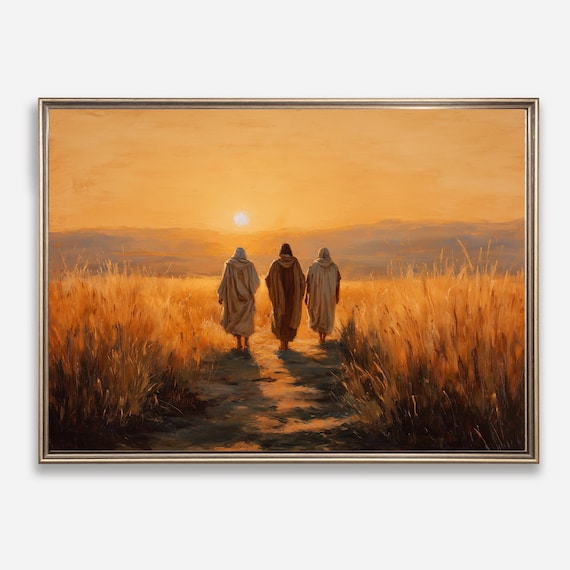
A More Powerful Image: The Road to Emmaus

If the flat tire feels too ordinary, Scripture gives us a deeper picture.

On the road to Emmaus (Luke 24), two disciples walk with heavy hearts. They are stuck. They are doing exactly what my stubborn self does—they are stating the truth of their disappointment and waiting for something to change.

“We had hoped that he was the one who was going to redeem Israel.”
That’s a true statement.
It’s also a stationary one.

Jesus joins them on the road. And what’s striking is not what He knows—but how He speaks.

He does not begin with correction.
He does not say, “You’re missing the point.”
He does not rush to set them straight.

Instead, the risen Christ asks a question:

“What are you discussing together as you walk along?” (Luke 24:17)

He knew the answer.
He was the answer.
And still—He asked.

Why?

Because questions create ownership.
Because questions invite movement.
Because truth, when it waits, can harden into despair—but wisdom, when it asks, opens a path forward.

Only after they speak—after they own their confusion and grief—does Jesus begin to teach. The lecture comes after the question, not before it. And by the end of the road, their hearts burn, their eyes open, and their feet turn back toward Jerusalem.

That is not accidental.
That is formative.

We can be right and still go nowhere.
We can say, “They should’ve known.”
All true. All satisfying. All useless if nothing changes.

Sometimes the most loving thing we can do is follow a statement with a question:

Will you help me?
What are we going to do next?
Do you understand?

Not because truth is weak—
but because wisdom wants movement.

Most of us don’t lack clarity.
We lack follow-through.

The stubborn self speaks first and loudly. It announces the problem and waits. The better self waits a beat longer and asks the harder question—not because it’s fair, but because it works.

Wisdom rarely sounds triumphant.
It sounds practical.


Soli Deo Gloria 


Saturday, December 27, 2025

Gratitude Has a Way of Crowding Things Out

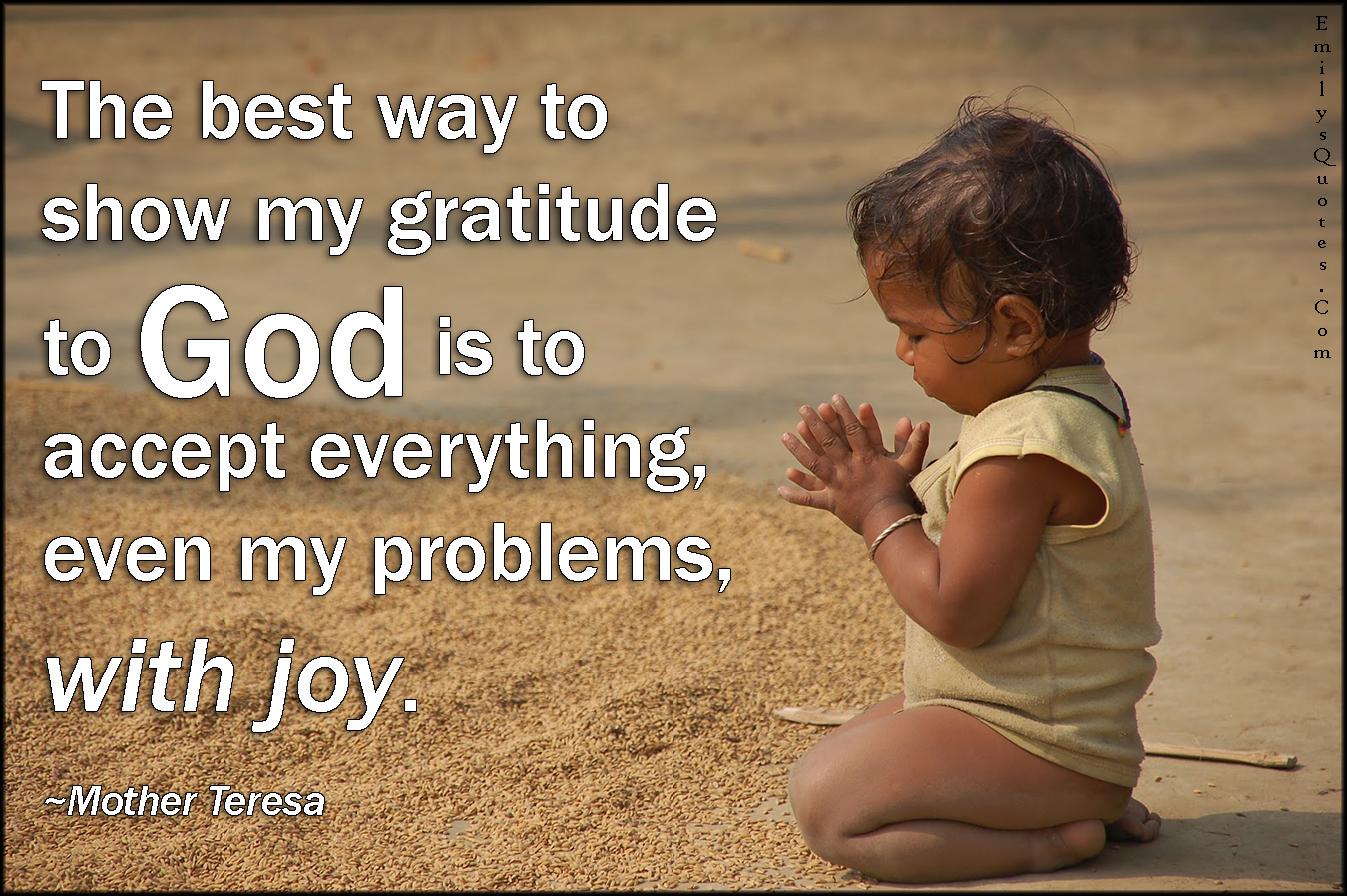
 EmilysQuotes.Com - best way, gratitude, thankful, God, accept, problems, joy, inspirational, positive, Mother Teresa


I’ve noticed something about the human heart—mostly by watching my own.

When regret takes the wheel, it doesn’t just visit. It settles in. It replays old scenes. It edits them. It adds dialogue that was never spoken. It tells me how things should have gone.

Anxiety does something similar, only it points the projector forward. It imagines conversations that haven’t happened, outcomes that aren’t guaranteed, futures God hasn’t revealed. It says, What if? and then refuses to stop talking.

But gratitude—true gratitude—doesn’t coexist peacefully with either one.

Not for long.

That’s not just preacher talk. Psychologists have noticed it too. They say the mind can’t sustain gratitude while simultaneously dwelling in regret or anxiety. Attention doesn’t work that way. You can visit both neighborhoods, but you can’t live in both houses at once.

Scripture has been saying that for a long time.

Paul doesn’t say, “Don’t be anxious—just stop it.” He knows better. Instead, he tells us to bring our requests to God with thanksgiving (Phil. 4:6–7). That phrase matters. Thanksgiving isn’t garnish. It’s the mechanism. Gratitude redirects the soul. And when it does, peace stands guard.

That’s the part we often miss. Gratitude doesn’t erase hard things. It re-anchors us while they’re still there.

Regret chains us to a past we cannot change.
Anxiety enslaves us to a future we do not control.
Gratitude brings us back to the present—where God actually is.

That’s why Scripture keeps telling God’s people to remember. Remember the exodus. Remember the wilderness. Remember the manna. Remember the cross. Gratitude is not sentimentality; it’s memory rightly ordered. It says, This is what God has already done. And if He has done that, then I am not alone now.

We sometimes treat gratitude like a personality trait. Scripture treats it like a discipline of faith.

When we give thanks, we aren’t pretending everything is fine. We are confessing something deeper—that God has acted, God is acting, and God will not abandon His people. Gratitude trains the eyes to see that reality again.

And here’s the quiet grace of it: gratitude doesn’t shout regret down. It simply leaves less room for it. The same is true of anxiety. When thanksgiving fills the heart, fear finds itself crowded out—not by denial, but by trust.

I’ve learned this slowly, and usually the hard way. When I name what God has given—really name it—I feel the grip of if only and what if loosen. Not disappear. Loosen. Enough to breathe. Enough to pray honestly. Enough to rest.

Gratitude doesn’t deny sorrow or fear.
It just refuses to let them have the final word.

And most days, that’s enough to keep walking.

“Give thanks in all circumstances; for this is the will of God in Christ Jesus for you.”       (1 Thess. 5:18)

Not because all circumstances are good.
But because God is still present in them.

And gratitude—quiet, practiced, honest gratitude—keeps our hearts turned toward that truth when regret and anxiety are trying to pull us elsewhere.

That’s not denial.
That’s faith, learning where to stand.


Soli Deo Gloria 


Wednesday, December 10, 2025

“I Only See the Eye”


BLUF: For the Christian, the target is Christ.

I can still picture it the way the old stories paint it.

A king sits high in his hall, flanked by torches and banners, the kind of scene where every sound carries. He has a daughter—fair, beloved, watched over like a treasure—and he announces a contest. He will give her hand to the finest archer in all the kingdom of India.

But it won’t be an ordinary shot.

Out on the field stands a pole twenty feet high. At the top, a piece of wood juts out—only about a foot long—and on it sits an image of a fish. And on that fish is an eye, striking and unmistakable. In my mind it’s almost red, like it has its own stubborn little flame.

That eye is the target.

Two hundred yards away, archers step forward one by one. The distance mocks them. The height humbles them. The fish’s eye seems to stare back as if it knows how many strong men will miss.

Then Arjuna enters—the greatest warrior of them all.

The king asks him what he sees.

And Arjuna answers with the kind of simplicity that cuts through every distraction like a blade:

“I only see the eye.”

Not the pole
or the crowd.
Not the princess
or the reward.
Not the pressure.

Only the eye.

And he draws the bow and releases the arrow. And the eye is struck.

Now, I know little of what it means to stand with a bow in my hands— but there is a kind of bow you carry inside your chest. That tension between what I should do and what I feel like doing. The heavy awareness of other people’s opinions. The parade of possibilities marching across the mind when you’re trying to obey God: “What if I fail? What if I embarrass myself? What if the future goes sideways?”

And it’s not only fear that distracts us.

Sometimes it’s good things.

A blessing we want.
A relationship 
we don’t want to lose.
A plan we’ve built.
A reputation 
we’ve guarded.
A comfort 
we’ve come to rely on.

A hundred good reasons for us to take our eyes off the one thing we must see.

Then Christ comes to us—not with theatrics, but with a steady voice—and He says what He said long ago:

“Follow Me.”

And if we’re honest, we often answer Him like we’re surveying the whole field:

“Lord, I see the pole.”
“I see the wind.”
“I see the distance.”
“I see the crowd.”
“I see the risk.”
“I see the cost.”
“I see what they might say.”

And Christ doesn’t deny any of it.

But He calls us to a deeper clarity.

The Christian life does not run on scattered sight. It runs on a single gaze.

Scripture doesn’t merely tell us to believe in Jesus as an idea. It calls us to lay aside what clings so easily—and run our race with endurance—looking to Jesus. (Heb. 12:1–2)

Not glance.
Not check in occasionally.
Not add Him as one priority among many.

Fix.

That word feels like the archer’s stance—feet planted, shoulders set, hands steady, mind gathered up and brought to one point.

Christ does not only save us from sin. He gathers our scattered hearts. He reorders our vision. He teaches us what matters.

Because the world trains us to see everything except the thing that matters most.

It trains us to measure success by outcomes and applause.
To measure safety by control.
To measure faithfulness by how “smooth” life feels.

But Jesus teaches a different measurement.

He says, in effect, “Look at Me.”

Look at the cross, where love held steady.
Look at the empty tomb, where hope broke through.
Look at the reigning Christ, where history finds its center.
Look at the Shepherd, where your life is not a random drift but a guided path.

The older I get, the more I suspect spiritual maturity often looks less like adding more techniques—and more like simplifying the gaze.

Fewer frantic calculations.
Less mental noise.
Less living as if everything is urgent.

More steadiness.
More obedience.
More quiet courage.

More: “I only see the eye.”

And for the Christian, that “eye,” that center point, that single target isn’t a fish on a pole.

It’s Christ Himself.

It’s His face.
His words.
His promises.
His call.

So here’s a question I’ve started asking when my mind runs wild and my heart starts spinning:

“What am I looking at right now?”

Because that question exposes so much.

Am I looking at the opinions of others?
worst-case scenarios?
comfort?
control?
what I can’t fix?

Or am I looking at Jesus?

Not vaguely.
Not sentimentally.
But really looking—through prayer, through Scripture, through the simple act of obedience to my Lord.

And maybe that’s the invitation today.

Not to deny the pole exists.
Nor pretend the wind isn’t blowing.
Nor to act like the distance isn’t real.

But to gather our attention.
Quiet the inner crowd.
Set the heart in line.

And to say, in the face of a thousand distractions:

“Lord, by Your grace… I only see You.”


Soli Deo Gloria


Thursday, December 4, 2025

Strength That Bows: What David Teaches Us About Meekness and Humility


I still remember the first time I walked up to the edge of the Grand Canyon. I had seen pictures my whole life—postcards, coffee-table books, desktop wallpapers—but nothing prepares you for the real thing.

You walk toward a simple line in the desert, and then suddenly the world just… falls away. The air changes. The light opens up. And you’re standing there, not just looking at something big, but realizing how unbelievably small you are.

I didn’t feel frightened. I felt oriented. That canyon had its own kind of sermon: there is a God, and you are not Him.

I think of such things whenever I read the story of David preparing to face Goliath. We tend to picture him as swaggering—a boy with bravado and a sling. But that’s not what Scripture shows. David wasn’t confident in himself. He was confident in God. And that difference is everything.

When we talk about meekness (prautÄ“s) and humility (tapeinos)—those two rich biblical words that sit like precious stones in the New Testament—their meaning comes alive in David’s posture. Not swagger. Not insecurity. Something else. Something better.

Here’s what I mean.


What David Said About God Reveals His Meekness

David stood before Saul and remembered the lions and the bears—not as personal triumphs, but as evidence of God’s faithfulness.

  • He didn’t trust his own strength.

  • He anchored his confidence in God’s deliverance.

  • He acted with courage, but not self-assertion.

  • He saw his skill as something God could use, not something that proved his worth.

That is exactly what the New Testament means by prautÄ“s—strength under God’s authority, not self-elevation.

It’s the opposite of the clenched jaw and puffed chest we sometimes mistake for courage.
It’s boldness that has been tamed by reverence.


What David Said Before Goliath Reveals His Humility

Then David steps forward to meet the giant. And his words are some of the most God-saturated words in all of Scripture:

“I come to you in the name of the LORD of hosts…
…that all the earth may know that there is a God in Israel…
…the battle is the LORD’s.”

In those sentences you can hear humility in its purest biblical sense:

  • He does not seek personal glory.

  • He does not magnify his courage or skill.

  • He positions himself as God’s instrument.

  • He lowers himself so that God may be displayed.

In Greek, that is the spirit of tapeinos—the chosen lowliness that trusts God completely.

Humility is not thinking less of yourself; it is thinking of yourself less.
And nobody models that better than David standing in the valley.


The Beautiful Combination: Humility Feeding Meekness

Put these together and you get a picture of Christlike courage long before Christ put on flesh:

  • Humility (tapeinos): “I am small; God is great.”

  • Meekness (prautÄ“s): “I will use my strength under God’s command.”

This is the same pairing you hear from Jesus:
“I am praus and tapeinos of heart” (Matt. 11:29).
Gentle. Lowly. Strong. Surrendered.

David’s posture is not bravado.
It’s not self-importance.
It’s not hidden pride dressed up as piety.

It’s trust.
It’s dependence.
It’s the steady heartbeat of a soul aligned with God.


Why This Matters

I wonder how often we face our own giants thinking God needs us to be impressive.
We bring our resume, our competence, our well-crafted arguments.
We puff up just a little. Or maybe deflate in fear.

But the giants fall—not by self-confidence, and not by self-contempt—but by men and women who carry the same posture David carried into the valley:

  • Strong, but submitted

  • Courageous, but dependent

  • Bold, but God-centered

The battle is still the Lord’s.

And meekness and humility are still His chosen instruments.


A Closing Reflection

That day at the Grand Canyon, I stood there longer than I expected. Not because I understood the place, but because it helped me understand myself.

David stood in a different canyon—the Valley of Elah—but he carried the same clarity:
God is great, and we are His.

And maybe that’s the invitation to us today:
to bring our strength and boldness to God, to bow it before Him, and to move forward with a courage born not of self-confidence, but of surrender.

Not to be heroes.
But to be His instruments.


Soli Deo Gloria. 


Thursday, November 13, 2025

Pebbles and Dragons: How Grace Works Slowly


BLUF:
Grace rarely arrives with a flash of light. More often, it begins as a quiet irritation of truth—a small pebble of grace pressing in the soul until the heart can no longer ignore it. Our part is to speak wisely and kindly; God’s part is to awaken the heart.


When Eustace Scrubb first appeared in The Voyage of the Dawn Treader, he was the boy nobody liked—spoiled, cynical, and absolutely certain he was right. He mocked his cousins’ talk of Narnia as childish fantasy, dismissed courage as foolishness, and believed the world was made for his comfort. Then he found himself on a ship bound for the edge of the world, surrounded by people whose quiet strength he could neither understand nor outwit.

Eustace didn’t change overnight. Grace almost never works that way.

First came frustration, then loneliness, then—after a dragon’s hoard and a cursed sleep—the terrible realization that he had become the very thing his heart resembled: a dragon, greedy and isolated. Only then, when his own scales became unbearable, did he finally meet Aslan. The great Lion tore away the hide Eustace could not shed himself, layer after layer, until a raw and trembling boy stood new in the water.

Lewis writes, “It would be nice, and fairly nearly true, to say that from that time forth Eustace was a different boy. To be strictly accurate, he began to be a different boy.”

That line has always lingered with me—because that’s how most of us come to faith.

Greg Koukl once said his goal in evangelism isn’t to “close the deal,” but simply to put a stone in someone’s shoe—something that bothers them in a good way, something they can’t quite shake. Most people aren’t won by argument in a single flash of light. They’re drawn by a series of nudges, conversations, kindnesses, questions—small pebbles of truth that keep pressing on the soul until the Spirit brings them to life.

The apostle Paul described it this way:

“I planted, Apollos watered, but God gave the growth.” — 1 Corinthians 3:6

Jesus said it, too:

“One sows and another reaps... Others have labored, and you have entered into their labor.” — John 4:37–38

Conversion, like growth, is slow work. The seed sprouts, the stalk rises, the head forms, and then comes the grain (Mark 4:26–29). Most of us are sowers, not harvesters. Our task is not to force belief but to speak truth gently and leave it where God can make it grow.

Sometimes it’s a question. Sometimes a verse. Sometimes an act of mercy that disarms self-righteousness. Like the bishop’s candlesticks in Les Misérables, or the dragon’s tear that falls from Eustace’s eye—each moment is a pebble in the shoe of unbelief, and God knows exactly when the stone will finally turn into a seed.

So don’t despise the small encounters. Don’t measure your faithfulness by the harvest you can see. When you walk away from a conversation feeling like nothing changed, remember: you may have just placed a stone that heaven will someday call a cornerstone.


Soli Deo Gloria  


Thursday, November 6, 2025

The Sword and the Spring


 “Be on your guard; stand firm in the faith; be courageous; be strong. Let all that you do be done in love.”
1 Corinthians 16:13–14


When I was a boy growing up in Mesa, the desert wind would sometimes whip through the hay barns behind our house, scattering bits of straw and dust like tiny gold flecks in the sun. My friends and I used to build forts out of the hay bales—our own little citadels of courage. We'd defend them with broomsticks and bravery, pretending to be knights standing for something noble.

Even then, I suppose, there was something in me that believed good ought to stand its ground.

Years later, I’d read Jesus’ words and feel their weight:

“He that hath no sword, let him sell his garment, and buy one.”
Luke 22:36

It wasn’t about aggression. It was about readiness. Jesus was sending His disciples into a hostile world—not to conquer by force, but to stand with conviction when the world pressed hard against truth. The sword symbolized vigilance—wisdom sharpened on the stone of reality.

Then there’s the proverb:

“Like a trampled spring and a polluted well is a righteous man who gives way before the wicked.”
Proverbs 25:26

If the sword is readiness, the spring is purity. When we compromise truth or yield to fear, the well of our witness grows murky. And the world, already thirsty for meaning, finds no refreshment in us. In every generation, believers must decide: will we be clear water or muddy runoff?

David gives us the final note:

“Praise be to the Lord my Rock, who trains my hands for war, my fingers for battle.”
Psalm 144:1

It’s not the war of vengeance, but the war of faithfulness. God trains us for the inward fight—to resist cynicism, to hold truth with love, to battle despair with hope. The Christian life remains a fight, not of swords but of spirit, and every act of obedience is a strike against the darkness.

So the theme still holds. Whether in the dust of ancient Israel or the noise of our modern world, God calls His people to a steady, prepared righteousness—the kind that neither lashes out nor gives in. To carry the sword of readiness and keep the spring of our soul clear is to live with both courage and clarity.

Prepared righteousness—and that’s just one reason we should support a Christian nation.
For who but the Christian is equipped to answer when God says, “Whom shall I send?”
The faithful reply, “Here am I. Send me.”

It’s not about ruling over others but about serving under Christ—bringing truth, justice, and peace into every sphere, making safe a land that can care for the vulnerable.
A Christian nation is one where righteousness is prepared, not presumed; where conviction meets compassion; where readiness bows before the Lord who trains our hands for battle.


A Prayer for Strength and Steadiness

Lord, train my hands for the battles of the heart.
Keep my convictions sharp and my spirit faithful.
Make me neither timid nor rash,
but steadfast in truth and faithful in love.
Let my life be a spring unpolluted,
and my readiness a sword unsheathed only at Your command.
Amen.

Soli Deo Gloria


Saturday, November 1, 2025

The Truth That Loves Enough to Correct


When I read a recent blog that said, “Jesus didn’t debate—He just loved,” I found myself muttering, "What in the wide-wide world of sports are you talking about?"  I get what the writer meant. They were trying to highlight the compassion of Christ—the gentleness, the mercy, the way He met people where they were. But something in me couldn’t let it rest there. Because love that never corrects isn’t love at all—it’s sentimentality.

Jesus loved people deeply. And because He loved them deeply, He spoke truth to them—sometimes in ways that unsettled, sometimes in ways that offended, but always in ways that invited transformation.

Think about that conversation between Jesus and Pilate in John 18. It wasn’t a heated exchange, but it was most certainly a debate—a collision of two worldviews. Pilate, the Roman governor, was trying to pin Jesus down on the charge of being a political threat: “Are you the King of the Jews?” Jesus could have simply said yes or no. Instead, He pressed deeper: “Do you say this of your own accord, or did others say it to you about Me?”

In that question alone, Jesus turned the tables. He wasn’t defending Himself; He was exposing Pilate’s assumptions. He was leading Pilate toward truth—toward the uncomfortable realization that power and truth are not the same thing, and that the real Kingdom stands above all earthly ones.

Then came the defining line: “My kingdom is not of this world… Everyone who is of the truth listens to my voice.”

Pilate’s reply, still echoing in the corridors of history, was the question of an age unwilling to bow: “What is truth?”

That’s the heart of it, isn’t it? Jesus loved enough to debate—not to win arguments, but to win hearts back to reality. He dismantled falsehood because falsehood enslaves. He confronted error because error blinds. Whether with Pharisees or disciples, He always took thoughts captive and made them obedient to the truth of God’s Kingdom.

Somewhere along the way, our culture has decided that correction and compassion can’t share the same sentence. But in Jesus, they always did. He is Truth embodied and Love incarnate—and the two are never at odds.

Maybe the most Christlike thing we can do is to recover that same balance: to love people enough to tell them the truth, and to tell the truth in such a way that they feel loved.


“Everyone who is of the truth listens to My voice.” — John 18:37

Closing Prayer:
Lord Jesus, help me love as You loved—boldly, wisely, and truthfully. Guard me from the kind of love that fears correction, and from the kind of truth that lacks compassion. Let both dwell together in me, as they do perfectly in You. Amen.

Soli Deo Gloria

Thursday, October 30, 2025

When “Show Me a Verse” Misses the Point


When I was a boy, we used to argue about everything from baseball stats to who could out-throw dirt clods in the field behind our house. At some point, the argument always came down to, “Prove it!” It was our way of saying, show me the evidence. And honestly, that wasn’t such a bad instinct—it forced us to put our words to the test.

I see that same spirit sometimes when people say, “Show me a verse.” It’s a good impulse—Scripture should indeed be our measure. But when Sola Scriptura gets flattened into Solo Scriptura—as though God gave us verses without minds to reason or a church to remember—it stops being the beautiful doctrine the Reformers intended and becomes weaponized into something far thinner.


Scripture Alone, Not Scripture Isolated

The Reformers never meant Sola Scriptura to mean that the Bible is the only source of truth. They meant it is the only source of infallible authority—the ultimate one, the authority that governs all others. Reason, tradition, and the faithful teaching of the Church all have their place. But they stand beneath Scripture, not beside it.

Even Martin Luther, standing before the Emperor at the Diet of Worms, said:

“Unless I am convinced by the testimony of the Scriptures or by evident reason… here I stand.”

That last phrase—or by evident reason—matters. Luther wasn’t rejecting the role of thought, logic, or inference. He knew that to read Scripture faithfully is to reason faithfully. God didn’t bypass the mind when He inspired the Word; He awakened it.

If preaching were based on Solo Scriptura—Scripture alone in isolation—then the preacher would simply rise, read a passage, and sit down saying, “Res ipsa loquitur.” (The thing speaks for itself.)

But Scripture does not interpret itself apart from the Spirit or the sanctified reasoning of the church. The Word of God is living, yes, but it still calls for faithful handling, for hearts and minds engaged in understanding and obedience.


The Essence of Sola Scriptura

The essence of Sola Scriptura is basing one’s spiritual life on the Bible alone and rejecting any tradition or teaching that is not in full agreement with Scripture. The doctrine arose as a direct response to the traditions of the Roman Catholic Church that had grown far beyond what Scripture supported. The Reformers weren’t trying to destroy tradition; they were trying to purify it—calling the church back to the authority of God’s Word as the final and sufficient rule of faith.

As Paul wrote:

“Do your best to present yourself to God as one approved, a workman who does not need to be ashamed and who correctly handles the word of truth.”
2 Timothy 2:15

That verse captures the heart of Sola Scriptura—to handle God’s Word rightly, not according to man’s imagination, but with reverent precision, humility, and care.

We must also remember that even within Scripture, words have meanings, and meanings must be interpreted. There is no meaning without interpretation. We are charged with rightly dividing the word of truth—and that involves meditating on his Word.  His  word is clear, but not simplistic. It invites careful, Spirit-guided reason and reflection. 


The Proof Text and the Pattern

So yes, by all means—ask for the verse. But remember that the Bible often teaches by pattern, context, syntax and history as much as by the plain words of proof text. The Trinity, the canon itself, even the Sabbath principle—all are truths drawn by what the Westminster divines called good and necessary consequence. These are truths we reach not by ignoring reason, but by submitting our reason to revelation.

When someone says “show me a verse,” what they often mean is, “help me see where Scripture leads us.” That’s a good instinct if the goal is understanding. But if it’s a demand for a single sentence to carry the whole weight of a doctrine, that’s not how truth usually works. God reveals Himself in a story, in a sweep, in a tapestry of meaning that requires a mind illumined by the Spirit.


Standing Firm, Thinking Deeply

Luther’s “Here I stand” wasn’t a declaration of stubbornness—it was a confession of submission. Scripture stood above him, not beneath him. But his mind wasn’t turned off—it was engaged, wrestling, persuaded. The same should be true for us.

To hold to Sola Scriptura faithfully is to believe that God’s Word governs our thought, but that our thought must still do the work of seeking, connecting, discerning. We don’t abandon reason to honor revelation; we bring reason to its knees before it.


Closing Reflection

When you hear someone say, “Show me a verse,” hear it as an invitation—but also as a challenge to go deeper than verse-hunting. The Word of God is not a collection of slogans. It’s a living testimony that invites the whole person—heart, mind, and soul—into submission to its truth.

Soli Deo Gloria


Ezra Discipleship Group

Falling Down and Rising Again

  We do not prove we belong to Christ by never falling. We prove it by rising — because He raises us. When I was a boy, there were two hay b...