Tuesday, December 30, 2025

When Truth Waits and Wisdom Asks

Image


I don’t remember the exact words, but I remember the feeling.

There was a moment when part of me insisted it had done enough. I said the tire was flat. That should have been sufficient. Another part of me—quieter, steadier—asked a different question. Did you ask them to help you fix it?

That’s usually how it goes.
My stubborn self states the truth and waits.
My better self asks the question that moves things forward.

My Stubborn Self:
“It was enough for me to tell them the tire was flat. They should’ve known what to do.”

My Better Self:
“They should’ve. No argument there. But did you ask them to help you fix it?”

My Stubborn Self:
“No. That shouldn’t be necessary.”

My Better Self:
“Necessary? Maybe not. Effective? Almost always.”

There’s a pause there—the kind where heels dig in.

My Stubborn Self:
“If people need to be told what to do, that’s on them.”

My Better Self:
“Maybe. But if the goal is movement, not moral victory, questions move things that statements don’t.”

That’s the lesson I keep relearning.

Statements describe reality.
Questions change it.

That’s why Navy commands get repeated back—not for ceremony, but for clarity and follow-through. That’s why a good mechanic doesn’t just say, “Your tires are wearing unevenly,” and walk away. He asks, “Do you want us to rotate them?”

Not because the truth was unclear.
Not because the listener was dull.
But because truth aims at fruit.

A More Powerful Image: The Road to Emmaus

If the flat tire feels too ordinary, Scripture gives us a deeper picture.

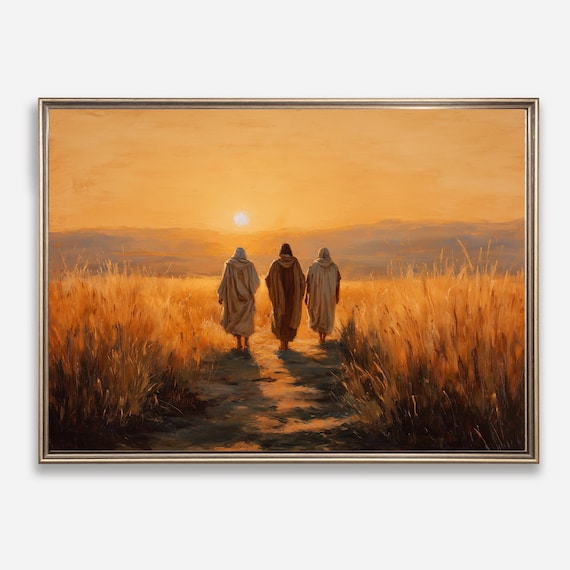
On the road to Emmaus (Luke 24), two disciples walk with heavy hearts. They are stuck. They are doing exactly what my stubborn self does—they are stating the truth of their disappointment and waiting for something to change.

“We had hoped that he was the one who was going to redeem Israel.”
That’s a true statement.
It’s also a stationary one.

Jesus joins them on the road. And what’s striking is not what He knows—but how He speaks.

He does not begin with correction.
He does not say, “You’re missing the point.”
He does not rush to set them straight.

Instead, the risen Christ asks a question:

“What are you discussing together as you walk along?” (Luke 24:17)

He knew the answer.
He was the answer.
And still—He asked.

Why?

Because questions create ownership.
Because questions invite movement.
Because truth, when it waits, can harden into despair—but wisdom, when it asks, opens a path forward.

Only after they speak—after they own their confusion and grief—does Jesus begin to teach. The lecture comes after the question, not before it. And by the end of the road, their hearts burn, their eyes open, and their feet turn back toward Jerusalem.

That is not accidental.
That is formative.

We can be right and still go nowhere.
We can say, “They should’ve known.”
All true. All satisfying. All useless if nothing changes.

Sometimes the most loving thing we can do is follow a statement with a question:

Will you help me?
What are we going to do next?
Do you understand?

Not because truth is weak—
but because wisdom wants movement.

Most of us don’t lack clarity.
We lack follow-through.

The stubborn self speaks first and loudly. It announces the problem and waits. The better self waits a beat longer and asks the harder question—not because it’s fair, but because it works.

Wisdom rarely sounds triumphant.
It sounds practical.


Soli Deo Gloria 


Saturday, December 27, 2025

Gratitude Has a Way of Crowding Things Out

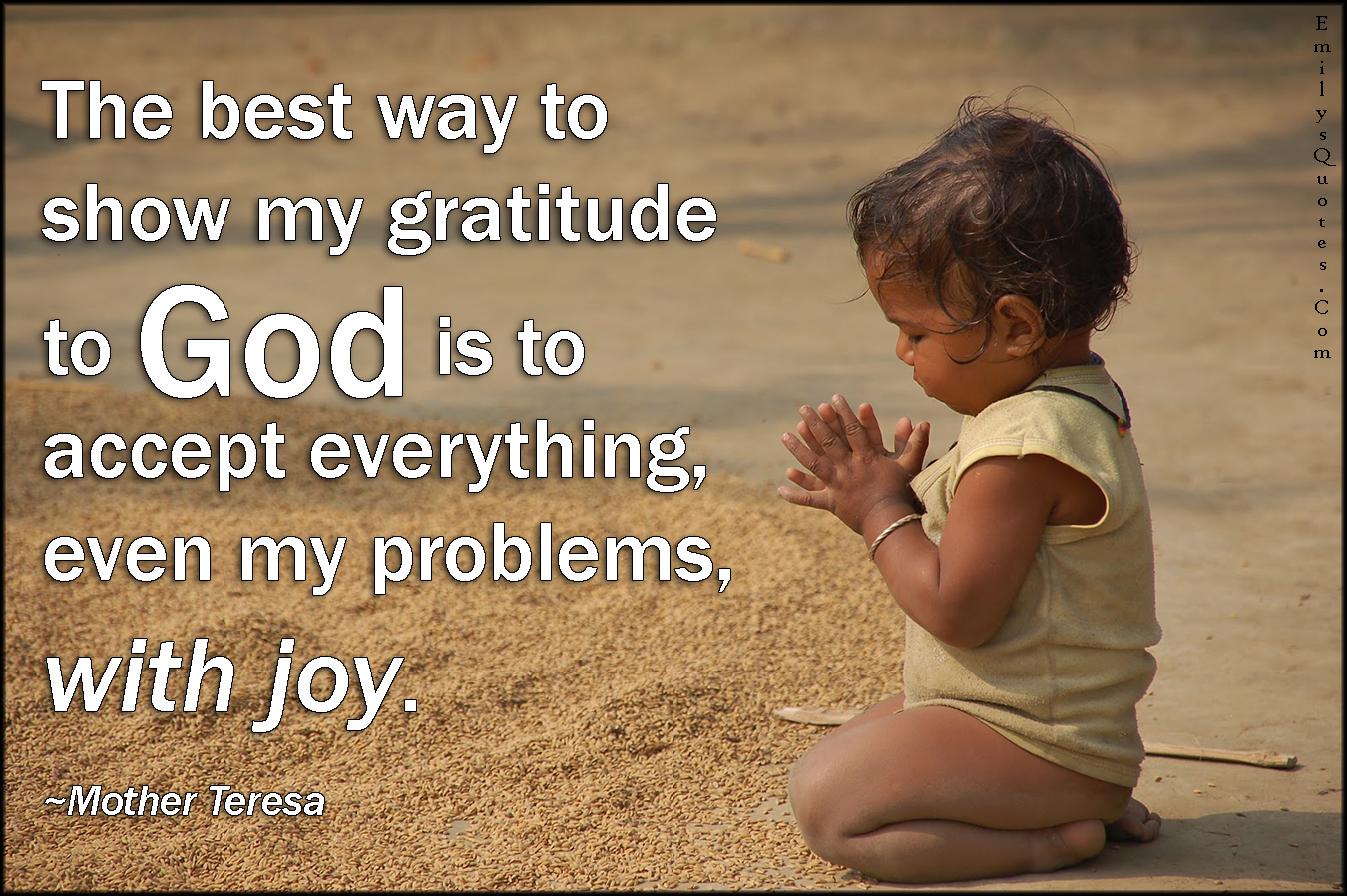
 EmilysQuotes.Com - best way, gratitude, thankful, God, accept, problems, joy, inspirational, positive, Mother Teresa


I’ve noticed something about the human heart—mostly by watching my own.

When regret takes the wheel, it doesn’t just visit. It settles in. It replays old scenes. It edits them. It adds dialogue that was never spoken. It tells me how things should have gone.

Anxiety does something similar, only it points the projector forward. It imagines conversations that haven’t happened, outcomes that aren’t guaranteed, futures God hasn’t revealed. It says, What if? and then refuses to stop talking.

But gratitude—true gratitude—doesn’t coexist peacefully with either one.

Not for long.

That’s not just preacher talk. Psychologists have noticed it too. They say the mind can’t sustain gratitude while simultaneously dwelling in regret or anxiety. Attention doesn’t work that way. You can visit both neighborhoods, but you can’t live in both houses at once.

Scripture has been saying that for a long time.

Paul doesn’t say, “Don’t be anxious—just stop it.” He knows better. Instead, he tells us to bring our requests to God with thanksgiving (Phil. 4:6–7). That phrase matters. Thanksgiving isn’t garnish. It’s the mechanism. Gratitude redirects the soul. And when it does, peace stands guard.

That’s the part we often miss. Gratitude doesn’t erase hard things. It re-anchors us while they’re still there.

Regret chains us to a past we cannot change.
Anxiety enslaves us to a future we do not control.
Gratitude brings us back to the present—where God actually is.

That’s why Scripture keeps telling God’s people to remember. Remember the exodus. Remember the wilderness. Remember the manna. Remember the cross. Gratitude is not sentimentality; it’s memory rightly ordered. It says, This is what God has already done. And if He has done that, then I am not alone now.

We sometimes treat gratitude like a personality trait. Scripture treats it like a discipline of faith.

When we give thanks, we aren’t pretending everything is fine. We are confessing something deeper—that God has acted, God is acting, and God will not abandon His people. Gratitude trains the eyes to see that reality again.

And here’s the quiet grace of it: gratitude doesn’t shout regret down. It simply leaves less room for it. The same is true of anxiety. When thanksgiving fills the heart, fear finds itself crowded out—not by denial, but by trust.

I’ve learned this slowly, and usually the hard way. When I name what God has given—really name it—I feel the grip of if only and what if loosen. Not disappear. Loosen. Enough to breathe. Enough to pray honestly. Enough to rest.

Gratitude doesn’t deny sorrow or fear.
It just refuses to let them have the final word.

And most days, that’s enough to keep walking.

“Give thanks in all circumstances; for this is the will of God in Christ Jesus for you.”       (1 Thess. 5:18)

Not because all circumstances are good.
But because God is still present in them.

And gratitude—quiet, practiced, honest gratitude—keeps our hearts turned toward that truth when regret and anxiety are trying to pull us elsewhere.

That’s not denial.
That’s faith, learning where to stand.


Soli Deo Gloria 


Wednesday, December 10, 2025

“I Only See the Eye”


BLUF: For the Christian, the target is Christ.

I can still picture it the way the old stories paint it.

A king sits high in his hall, flanked by torches and banners, the kind of scene where every sound carries. He has a daughter—fair, beloved, watched over like a treasure—and he announces a contest. He will give her hand to the finest archer in all the kingdom of India.

But it won’t be an ordinary shot.

Out on the field stands a pole twenty feet high. At the top, a piece of wood juts out—only about a foot long—and on it sits an image of a fish. And on that fish is an eye, striking and unmistakable. In my mind it’s almost red, like it has its own stubborn little flame.

That eye is the target.

Two hundred yards away, archers step forward one by one. The distance mocks them. The height humbles them. The fish’s eye seems to stare back as if it knows how many strong men will miss.

Then Arjuna enters—the greatest warrior of them all.

The king asks him what he sees.

And Arjuna answers with the kind of simplicity that cuts through every distraction like a blade:

“I only see the eye.”

Not the pole
or the crowd.
Not the princess
or the reward.
Not the pressure.

Only the eye.

And he draws the bow and releases the arrow. And the eye is struck.

Now, I know little of what it means to stand with a bow in my hands— but there is a kind of bow you carry inside your chest. That tension between what I should do and what I feel like doing. The heavy awareness of other people’s opinions. The parade of possibilities marching across the mind when you’re trying to obey God: “What if I fail? What if I embarrass myself? What if the future goes sideways?”

And it’s not only fear that distracts us.

Sometimes it’s good things.

A blessing we want.
A relationship 
we don’t want to lose.
A plan we’ve built.
A reputation 
we’ve guarded.
A comfort 
we’ve come to rely on.

A hundred good reasons for us to take our eyes off the one thing we must see.

Then Christ comes to us—not with theatrics, but with a steady voice—and He says what He said long ago:

“Follow Me.”

And if we’re honest, we often answer Him like we’re surveying the whole field:

“Lord, I see the pole.”
“I see the wind.”
“I see the distance.”
“I see the crowd.”
“I see the risk.”
“I see the cost.”
“I see what they might say.”

And Christ doesn’t deny any of it.

But He calls us to a deeper clarity.

The Christian life does not run on scattered sight. It runs on a single gaze.

Scripture doesn’t merely tell us to believe in Jesus as an idea. It calls us to lay aside what clings so easily—and run our race with endurance—looking to Jesus. (Heb. 12:1–2)

Not glance.
Not check in occasionally.
Not add Him as one priority among many.

Fix.

That word feels like the archer’s stance—feet planted, shoulders set, hands steady, mind gathered up and brought to one point.

Christ does not only save us from sin. He gathers our scattered hearts. He reorders our vision. He teaches us what matters.

Because the world trains us to see everything except the thing that matters most.

It trains us to measure success by outcomes and applause.
To measure safety by control.
To measure faithfulness by how “smooth” life feels.

But Jesus teaches a different measurement.

He says, in effect, “Look at Me.”

Look at the cross, where love held steady.
Look at the empty tomb, where hope broke through.
Look at the reigning Christ, where history finds its center.
Look at the Shepherd, where your life is not a random drift but a guided path.

The older I get, the more I suspect spiritual maturity often looks less like adding more techniques—and more like simplifying the gaze.

Fewer frantic calculations.
Less mental noise.
Less living as if everything is urgent.

More steadiness.
More obedience.
More quiet courage.

More: “I only see the eye.”

And for the Christian, that “eye,” that center point, that single target isn’t a fish on a pole.

It’s Christ Himself.

It’s His face.
His words.
His promises.
His call.

So here’s a question I’ve started asking when my mind runs wild and my heart starts spinning:

“What am I looking at right now?”

Because that question exposes so much.

Am I looking at the opinions of others?
worst-case scenarios?
comfort?
control?
what I can’t fix?

Or am I looking at Jesus?

Not vaguely.
Not sentimentally.
But really looking—through prayer, through Scripture, through the simple act of obedience to my Lord.

And maybe that’s the invitation today.

Not to deny the pole exists.
Nor pretend the wind isn’t blowing.
Nor to act like the distance isn’t real.

But to gather our attention.
Quiet the inner crowd.
Set the heart in line.

And to say, in the face of a thousand distractions:

“Lord, by Your grace… I only see You.”


Soli Deo Gloria


Thursday, December 4, 2025

Strength That Bows: What David Teaches Us About Meekness and Humility


I still remember the first time I walked up to the edge of the Grand Canyon. I had seen pictures my whole life—postcards, coffee-table books, desktop wallpapers—but nothing prepares you for the real thing.

You walk toward a simple line in the desert, and then suddenly the world just… falls away. The air changes. The light opens up. And you’re standing there, not just looking at something big, but realizing how unbelievably small you are.

I didn’t feel frightened. I felt oriented. That canyon had its own kind of sermon: there is a God, and you are not Him.

I think of such things whenever I read the story of David preparing to face Goliath. We tend to picture him as swaggering—a boy with bravado and a sling. But that’s not what Scripture shows. David wasn’t confident in himself. He was confident in God. And that difference is everything.

When we talk about meekness (prautēs) and humility (tapeinos)—those two rich biblical words that sit like precious stones in the New Testament—their meaning comes alive in David’s posture. Not swagger. Not insecurity. Something else. Something better.

Here’s what I mean.


What David Said About God Reveals His Meekness

David stood before Saul and remembered the lions and the bears—not as personal triumphs, but as evidence of God’s faithfulness.

  • He didn’t trust his own strength.

  • He anchored his confidence in God’s deliverance.

  • He acted with courage, but not self-assertion.

  • He saw his skill as something God could use, not something that proved his worth.

That is exactly what the New Testament means by prautēs—strength under God’s authority, not self-elevation.

It’s the opposite of the clenched jaw and puffed chest we sometimes mistake for courage.
It’s boldness that has been tamed by reverence.


What David Said Before Goliath Reveals His Humility

Then David steps forward to meet the giant. And his words are some of the most God-saturated words in all of Scripture:

“I come to you in the name of the LORD of hosts…
…that all the earth may know that there is a God in Israel…
…the battle is the LORD’s.”

In those sentences you can hear humility in its purest biblical sense:

  • He does not seek personal glory.

  • He does not magnify his courage or skill.

  • He positions himself as God’s instrument.

  • He lowers himself so that God may be displayed.

In Greek, that is the spirit of tapeinos—the chosen lowliness that trusts God completely.

Humility is not thinking less of yourself; it is thinking of yourself less.
And nobody models that better than David standing in the valley.


The Beautiful Combination: Humility Feeding Meekness

Put these together and you get a picture of Christlike courage long before Christ put on flesh:

  • Humility (tapeinos): “I am small; God is great.”

  • Meekness (prautēs): “I will use my strength under God’s command.”

This is the same pairing you hear from Jesus:
“I am praus and tapeinos of heart” (Matt. 11:29).
Gentle. Lowly. Strong. Surrendered.

David’s posture is not bravado.
It’s not self-importance.
It’s not hidden pride dressed up as piety.

It’s trust.
It’s dependence.
It’s the steady heartbeat of a soul aligned with God.


Why This Matters

I wonder how often we face our own giants thinking God needs us to be impressive.
We bring our resume, our competence, our well-crafted arguments.
We puff up just a little. Or maybe deflate in fear.

But the giants fall—not by self-confidence, and not by self-contempt—but by men and women who carry the same posture David carried into the valley:

  • Strong, but submitted

  • Courageous, but dependent

  • Bold, but God-centered

The battle is still the Lord’s.

And meekness and humility are still His chosen instruments.


A Closing Reflection

That day at the Grand Canyon, I stood there longer than I expected. Not because I understood the place, but because it helped me understand myself.

David stood in a different canyon—the Valley of Elah—but he carried the same clarity:
God is great, and we are His.

And maybe that’s the invitation to us today:
to bring our strength and boldness to God, to bow it before Him, and to move forward with a courage born not of self-confidence, but of surrender.

Not to be heroes.
But to be His instruments.


Soli Deo Gloria. 


Ezra Discipleship Group

Falling Down and Rising Again

  We do not prove we belong to Christ by never falling. We prove it by rising — because He raises us. When I was a boy, there were two hay b...